Leave a comment

Try to escape a black hole and you’ll be burnt to a crisp, new paper cautions

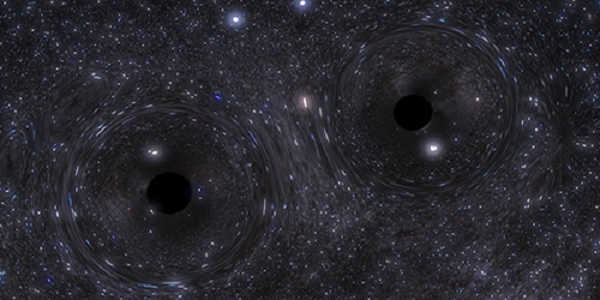
The event horizon of a black hole is either a deceptively peaceful void, or a fiery hellscape of doom, depending on how close you actually get, physicists have proposed.

The existence of this burning wall of fire on the event horizon has become one of the most contentious issues to hit theoretical physics in the past few years, and a couple of scientists from the University of Victoria in British Columbia, Canada have just put themselves in the mix with a controversial new paper that proposes two different realities for a black hole depending on your perspective.

But a little background info to get you up to speed first. The black hole firewall is a hypothetical phenomenon where an object generates so much energy when passing over the event horizon, it creates an actual wall of flames that engulfs anything in its path. Proposed in 2012, the hypothesis seeks to solve a fundamental problem with the most widely accepted explanation for what happens to matter when it encounters a black hole.

The problem goes like this. Back in the 1970s, theoretical physicists Stephen Hawking and Jacob Bekenstein showed that black holes emit radiation from the event horizon – now known as Hawking radiation. They proposed that a single emission of Hawking radiation involves two mutually entangled particles that form near the event horizon. One falls into the black hole, while the other shoots back out into the Universe as radiation.

Over a very long period of time, all this escaping mass will cause the entire black hole to start evaporating, and because quantum mechanics states that information in the Universe can never be irreversibly destroyed, Hawking and Bekenstein proposed that the information that’s been held by the dying black hole finally exits as Hawking radiation.

But here’s where things get tricky, because particles exiting as radiation in these late stages of the black hole’s lifespan must still be quantum entangled with the radiation that was expelled earlier. But now that they’re the outgoing particle, they also have to be quantum entangled with an ingoing partner, and this goes against a fundamental principle called ‘monogamy of entanglement’.

Monogamy of entanglement states that the outgoing particles being spewed forth from an evaporating black hole cannot be fully entangled with two independent systems at the same time. So on the one hand, these particles have to have polygamous, not monogamous, entanglement relationships, but on the other hand, they absolutely cannot, according to our current understand of the laws of physics.

So here we have an impossible situation, and the only way to resolve this so-called information paradox was to admit that one of three fundamental theories in physics that all play a part in this scenario are wrong: Einstein’s equivalence principle, which is part of his general theory of relativity; unitarity, which is part of quantum physics; or existing quantum field theory.

“To resolve the paradox, one of the three must be sacrificed, and nobody can agree on which one should get the axe,” says Jennifer Oulette over at Scientific American.

Enter, the black hole firewall. First proposed by a group of physicists lead by Joseph Polchinski from the University of California in Santa Barbara, the hypothesis is that this polygamous entanglement exists, but is somehow broken immediately as it forms, which would create extreme amounts of energy at the event horizon, literally giving rise to a burning wall of flames.

The proposal was met by great ire in the theoretical physics community, and not just because if it’s true, it means there’s something very wrong with Einstein’s general theory of relatively. “[A] firewall simply can’t appear in empty space, any more than a brick wall can suddenly appear in an empty field and smack you in the face,” Raphael Bousso, a string theorist at the University of California, Berkeley, said back in 2012.

And yet, actually disproving it hasn’t exactly been easy. “If there is an error in the firewall argument, the mistake is not obvious. That’s the hallmark of a good scientific paradox,” says Oulette.

galaxy

Fast-forward to today, and the black hole firewall remains the black sheep that many theoretical physicists want to get rid of, but haven’t been able to convincingly achieve, thanks to all of the paradoxes at play. And now physicists Werner Israel and Karun Thanjavur from the University of Victoria in British Columbia have released a pre-print paper arguing that this firewall could feasibly appear near the event horizon, but they offer a whole new explanation for what causes it:

Anil Ananthaswamy explains over at New Scientist:

“In order to stay put at a black hole’s horizon, you need to keep accelerating away from it. A phenomenon called the Unruh effect says that acceleration makes the empty space around you seem to heat up. Accelerating away from a solar mass black hole, this temperature can be as high as 1,010 Kelvin, says Israel.

‘You would feel as if you are engulfed in flames,’ he says. ‘This is your personal firewall.'”

But to anyone not sitting on the event horizon, the reality would be very different, they propose. “We argue that Hawking pair creation is entirely a low-energy process in which entanglements never arise,” the researchers conclude in their paper published online at arXiv.org.

So basically what they’re saying is there’s one reality for an ‘observer’ sitting on the event horizon – horrible, fiery death, not caused by the breaking of polygamous entanglements. “These observers are heated by acceleration radiation at the Unruh temperature and see pair creation at the horizon as a high-energy phenomenon,” they propose.

And then a whole other reality exists for a very distant observer – a low-energy process that does not give rise to quantum entanglement.

Only in theoretical physics can you propose two different realities like this with a straight face.

Now, the paper is yet to be peer-reviewed, and other scientists will likely have a field day with it in the coming weeks, with Steve Giddings from the University of California telling New Scientist that standard quantum theory doesn’t support all of their claims. But the information paradox still exists, and any serious attempt to get theoretical physicists coming up with and debating solutions to it is a worthwhile exercise – and an awesome one for us to watch.

“We have an indication that we need a new mechanism, a new ingredient to the story,” says Giddings.

Leave a comment

Seven Valuable Tips To Put Your Babies To Sleep

baby_sleeping

The world of parenting is turning tougher with children demanding more of your time. The toughest experience is putting your kid to sleep every night. Here are some useful tips from the “Sleep Solutions” challenge.

  1. Pediatricians opined that babies can sleep for 8 hours without parental intervention between the age of 4 to 6 months. Babies do not feel hungry in the night as they store sufficient food to pass the night. Every baby can sleep through the night without any parental guidance. It is but natural for parents to jump at the first wail of your baby and start holding and comforting them. Babies like this attention and try to take advantage.
  2. Babies’ eyelids turn heavy after the last feed in the day. Just place them on the bed and stay close enough to feel the baby. Initially leave the room for 30 seconds and slowly extend the time.Top-10-Baby-Sleep-Items
  3. It is important to relax before going to bed. Get everything done well in advance and avoid using electronic items like this could lead to sleep disturbances. Make relaxing a routine activity. You can also listen to some soothing music or read some book.
  4. A hungry baby always is restless so feed the babies well before putting them to sleep. If their little bellies are full, they sleep uninterruptedly. Just feed them before you hit the bed, so both of you have complete rest.
  5. Consistency is the key. Irrespective of whoever is responsible for putting the baby to sleep have to follow the same method whether it is during the day or at night. Each one following a different method can confuse the child and lead to sleep inconsistency.
  6. Keep a schedule for your child. Whether it is eating, nappy changing, sleeping it is important to keep the routine. This can help get into a cycle that can get their circadian rhythm right.
  7. Sleep time and wake time varies when the child is sick. Do not follow any schedules when the baby is having a fever, traveling teething or is not normal. During these situations take time to snuggle, hydrate, and cuddle.

Read Also White Collar Criminals Need To Be Identified Says Justice Department

Leave a comment

New Paper Suggests The Reason Why We Haven’t Found Alien Life Yet

alien

Growing up with sci-fi films and TV shows has really given us all an unrealistic idea of what the future (ie. the present) was going to be like. I genuinely thought we would have found alien life by now. Or they would’ve found us. But no.

Why is that, though? We’ve got crazy powerful telescopes and communication devices, as well as space travel being really advanced. Surely, by now we should’ve discovered… something?!

Well, a new paper seems to think that the reason behind it is that all is – and this sucks – that there isn’t any.

Aditya Chopra and Charles H. Lineweaver, both academics who work at the Planetary Science Institute, The Australian National University, have got a new theory that they call ‘The Gaian Bottleneck’. The premise behind it being that yes, the percentage of planets needed to create a habitable atmosphere are high, however they simply don’t remain that way for long enough.

The paper says: “In the Gaian bottleneck model, the maintenance of planetary habitability is a property more associated with an unusually rapid evolution of biological regulation of surface volatiles than with the luminosity and distance to the host star.

“Such a Gaian bottleneck suggests that (i) extinction is the cosmic default for most life that has ever emerged on the surfaces of wet rocky planets in the Universe and (ii) rocky planets need to be inhabited to remain habitable.”

The Independent put this all in words that you and I find it easy to understand… “the reason we haven’t found any aliens yet is that quite simply while the percentage of life-sustaining environments could be high enough, they’re not around long enough for them to evolve from the pools of primordial life.”