Leave a comment

Reading news paper – Why students should read newspapers

Leave a comment

Dirt infield on tap for Rogers Centre
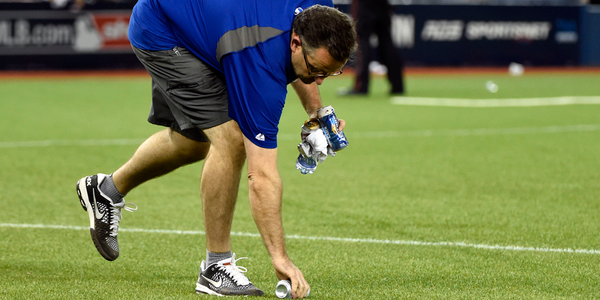
Rogers Centre

The Toronto Blue Jays are replacing the infield artificial turf at Rogers Centre with regulation dirt basepaths for the 2016 season, as the transition to a grass playing surface could be in the works if deemed feasible after a current study.

The cement floor at Rogers Centre in the basepaths will be removed, with 12 inches comprising layers of gravel, sand and clay will be installed in the excavated areas. All in all, an area of approximately 12,000 square feet will be configured to ensure proper moisture content and conditions suitable to a major-league playing surface. The infield and outfield will be unchanged, with AstroTurf 3D Xtreme (first installed in 2015) to remain.

toronto

“We are very excited to proceed with this project,” said Stephen Brooks, Senior Vice President, Business Operations, in a press release. “This will both improve the surface for the players and also enhance the atmosphere of the stadium for our fans.”

Rogers Centre is the only MLB ballpark with synthetic turf in the basepaths; Tropicana Field also sports synthetic turf, but the basepaths are dirt.

It’s no secret the Blue Jays front office wants to see a move to real grass in coming years; Paul Beeston had held out grass as a goal, and new team president Mark Shapiro has also talked about making over Rogers Centre. The issue: there’s currently no drainage system under the synthetic turf, and the need to reconfigure the grandstand to accommodate CFL football in the form of the Toronto Argonauts has prevented any changes. (In a unique configuration, the grandstand splits to make enough room for the longer CFL field.) At one point it seemed like a turf field was an inevitability, with the Argos moving to BMO Field (home of MLS’s Toronto FC) for the 2016 season, but the team is holding off on any final decisions until a University of Guelph report details the feasibility of the ballpark reconfiguration to allow for natural turf.

Leave a comment

Seven Must-Have Skills To Be A Multimedia Journalist

multimedia Journalist

Over the last few years, journalism has changed rapidly as technology allowed for easier access to the news. Today, with the widespread mobile use of the Internet, journalism is evolving into even more areas. A multimedia journalist must be able to share stories and newsworthy articles over a wider range of outlets by using a mixture of text, graphics, sound, images and videos.
To be a successful multimedia journalist, an individual must learn several specific skill sets. Here’s a look at seven crucial skills.
Organization
A multimedia journalist needs to be highly organized with the ability to prioritize activities in order to reach across different platforms while meeting deadlines. Depending on the story or article, you may need to:
Read and analyze different credible sources
Interview sources
Observe events
Review all the data
Follow up with sources for accuracy
All these tasks must be completed in a timely manner in order to have the article or story available for readers as quickly as possible.
Multimedia_JournalistComputer Knowledge
As a multimedia journalist, a computer will be an invaluable resource tool. You will need the ability to perform a variety of tasks on it, including:
Use of writing programs with the ability to copy-and-paste your article.
The ability to email an attachment or download the attachment to view the documents.
The knowledge to search the web for credible sources in an effective manner.
The knowledge to create an SEO-friendly headline and content to attract readers.
Webcam use
Content Management System (CMS)
The ability to upload a story or article to your employer’s system will be done via its Content Management System or CMS. The software will allow you to organize, edit and modify your information. The system allows for various functions to publish your information across various platforms when bundled with other software.
Photography & Video Skills
The ability to shoot quality photographs and record videos with clear sound is a must for a multimedia journalist. Go beyond the basic knowledge of learning how to take photos and videos, by learning how to edit and publish your video content.
Audio Editing
In some situations, the only way to receive an interview or credible data is through audio. As a multimedia journalist, you will need to know how to download, save, edit and analyze the audio clip. The clip may be a valuable piece of information, adding the right amount of audio content could make your entire story.
Social Media
With today’s advanced technology, news and stories go beyond newspapers, magazines, radio and television to a variety of social media outlets. The use of social media will allow your story to reach more readers across numerous platforms. You will need to know how each of these platforms works in order to utilize them to their fullest potential.
Creative Thinking
Regardless of the type of story or article, you will need the ability to think creatively to communicate your story clearly. You may use your creative thinking to:
Utilize your good people skills to conduct interviews and to use the material effectively.
The ability to piece a story together in an informative manner while keeping the reader’s attention.
Look back at an historic event and tell how the effects are still incorporated into today’s society.
A multimedia journalist is basically a widely skilled storywriter. The more skills you obtain, the higher in demand you will be for employment. Technology will always continue to change and advance, so learning new skills or updating current ones will help you keep up with the all changes and give you the ability to have your story heard around the globe.